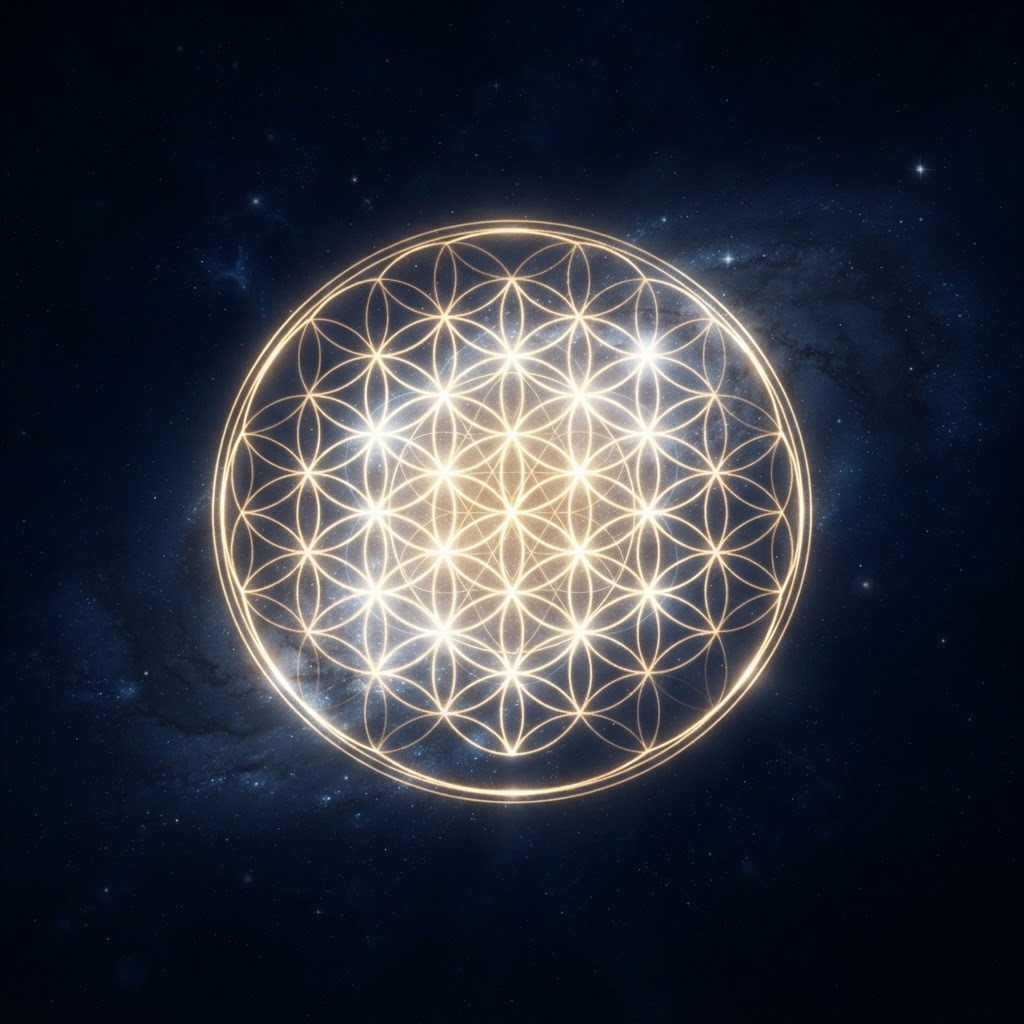
Sacred Geometry and the Language of Creation
Across every ancient civilization, the same geometric forms appear in their temples, their art, and their cosmologies. These shapes are not decorative — they are the universe's own signature.
Across every ancient civilization, the same geometric forms appear in their temples, their art, and their cosmologies. These shapes are not decorative — they are the universe's own signature.
When you look at the nautilus shell, the spiral of a galaxy, the branching of a river delta, or the arrangement of seeds in a sunflower, you encounter the same mathematical relationship: the golden ratio, approximately 1.618, known to the Greeks as phi.
The ancients did not discover phi by measuring shells. They encountered it in contemplation, in the attempt to understand the relationship between unity and multiplicity — between the one and the many. Phi is the number that describes how a whole can be divided into parts that retain the same proportion as the whole to one of its parts. It is the geometry of self-similarity, of the infinite nested within the finite.
The Flower of Life, a pattern of overlapping circles found carved into the walls of the Osirian Temple in Abydos, Egypt, and in temples across India and China, encodes within it every other sacred geometric form: the Vesica Piscis, the Fruit of Life, Metatron's Cube, and from that, all five Platonic solids.
The Platonic solids — tetrahedron, cube, octahedron, dodecahedron, and icosahedron — are the only three-dimensional forms in which every face is an identical regular polygon and every vertex touches the surface of a circumscribed sphere. Plato identified them with the classical elements: fire, earth, air, the cosmos, and water respectively.
Modern physics has rediscovered some of this wisdom. Quasicrystals, whose existence was denied until Dan Shechtman's Nobel Prize-winning work in the 1980s, arrange themselves according to the golden ratio. The carbon molecule C60 — buckminsterfullerene — is a truncated icosahedron. The cosmic microwave background, the faint afterglow of the Big Bang, shows correlations consistent with a dodecahedral geometry of space itself.
Perhaps the ancients were not being superstitious when they treated geometry as sacred. Perhaps they were simply paying very close attention.